Showing posts with label Politics. Show all posts

Wednesday, December 14, 2011

From Chennai to Mullaperiyar


The two lane road from Dindigul district in Tamil Nadu to Kumily, the border town in Kerala, is around 140 kms long. In this stretch, I could notice a marked difference from the barren lands which characterised most parts of the highway from Chennai till Dindigul. Paddy fields were visible all around on both sides of this rather narrow road. Halfway through this road, we entered Theni district which shares its border with Kerala. The variety of crops increased even further. Vast sugarcane fields, corn fields, vineyards, banana plantations and a myriad other cereals and millets, many of which I failed to identify.


Some glimpses of the prosperous Theni district 


The rain poured intermittently. A bike trip spanning 600 Km one way, when the meteorology department had already given a prediction of ‘heavy rains all over south India for the next 48 hours’ , slightly bordered on the insane. It did not help matters either that we were travelling in a bike that was meant for short city rides only. But, this did provide us with the luxury of stopping at each of those fields and see for ourselves what is being cultivated and where the water was coming from. Yes, the water, flowing out from a dilapidated 115-year-old dam situated in another state.
                                       
An agricultural family near Dindigul

                                     
Corn fields in Cumbum, Theni district


The story of Mullaperiyar dam is now familiar to everyone. Or, so we think. In my interactions with random people in Chennai, I realized that the massiveness of this issue is confined to the borders of Kerala. Most of them were unaware of even the basic facts or believed the Sun TV version of it. They do not know the fact that the engineer who built the dam way back in 1895 gave it a life span of 50 years. They do not know that it was built with surki and that currently it has a crack running through its full span. They also do not know that it is situated in a highly seismic zone and a quake above 6.0 in the Richter scale can bring this dam down. And, it is this realization that led two of us to travel down to the place, study the issue and spread the message. Let’s get back to the journey.

Cumbum and Gudalur are the last villages on the Tamil Nadu side. After this, the road starts winding up. The air gets misty. Kerala is situated on the other side of these hills. As we neared the Kerala border, we came across the penstock pipes of a hydro electric power generation plant at lower camp. This is the Periyar power plant, where Tamil Nadu generates electricity using the Mullaperiyar water. The original deed was signed in 1895 with the agreement to use the water for irrigation purpose alone. And, here we have a full fledged power plant. Tamil Nadu had tried to get permission from Kerala for the power plant in the late 40s. But when they saw that support was hard to come by, they started work on the power station in 1955 without waiting for the permission. According to the data presented in Sasidharan Mangathil’s book on Mullaperiyar, Tamil Nadu is now generating 100 crores worth of electricity from Mullaperiyar, whereas Kerala is paid just 7.75 lakhs.

By the time we reached the border, it was well past 12 noon. The border check post was still hidden in the mist. We got into the first shop at the border to ask for directions. There, few people were discussing three small quakes (measuring around 3 on the Richter scale each) that happened near the dam that morning.  According to the Kerala Government, the Mullaperiyar area has experienced 22 earthquakes of around 3.0 in the richter scale since July this year. The Tamil Nadu Government has alleged that this is a gross exaggeration and claimed the number to be not more than two. But I could see from the ground that these reports of earthquakes were not fake. These are people who experienced it firsthand. The tension in the atmosphere was palpable.

Our first aim was to visit the dam, the success of which we never truly believed in. After long talks with forest officials and calling up some others, we realized that getting anywhere near the dam is impossible. And so, we set out to visit the protest venue in Chappath and to meet the locals living in the areas close to the dam. A board hung in front of the protest venue read ‘1801’. The Mullaperiyar samara samithi (Mullaperiyar protest council) began its protest movement for a new dam exactly 1801 days back.  It is an apolitical movement started by the people in the border villages of Idukki. Prof C.P.Roy, the man who started this movement says, “We are ready to give more than enough water for Tamil Nadu. We are just begging for our lives. We want a new dam here.” This sentiment is shared by most of the people in these areas.
                                
A local farmer stands in front of the Mullaperiyar protest venue in Chappath. The board reads '1801', the number of days since the protests started


The protestors

The protest venue

One thing that surprised me was the number of Tamilians sitting at the protest venue demanding a new dam.  Curious to know their take on the issue, I started talking to some of them and surprisingly they had harsh words to convey to Jayalalithaa and Vaiko. Majority of those living in Peerumedu, Devikulam, Munnar etc are Tamils. “Jayalalitha says she cares for the lives of Tamils. So what about Tamilians like me living downstream this dangerous dam? What about our Malayali brothers and sisters? ,” asks S. Daniel, a supervisor at a corn estate in chappath village, one of the places that will be affected first if the Mullaperiyar dam breaks. Daniel’s father Selvaraj was one of the lakhs of Tamilians who migrated from different parts of Tamil Nadu and settled in the border district of Idukki many decades back.

One of the Tamilians whom we interviewed. He has been living in Idukki for the past many decades. He has harsh words for Jayalalithaa and Vaiko (with English subtitles)


 There are no hate speeches or violent slogans here, only a populace living under constant fear of a massive flood. From tea shops to Government offices, the subject of discussion is just the same. Mini, a medical shop owner here says, “My daughter finds it hard to sleep at night. Elders in our locality take turns to sleep at night. Everyone is living under the fear of being washed away in sleep.” Her daughter celebrated her 6th birthday by joining the relay fast at the protest venue in Chappath.

There have been allegations from various quarters that the media and politicians in Kerala are creating a mass hysteria with ulterior motives. But the people in these areas refute any such suggestions. “We have been living under constant fear since the 1970s. Our voices started going outside only recently,” says Shaji Joseph, one of the protestors. The fears have also led to small scale migrations. According to an employee in a tea plantation here, some of his former co-workers have left this place after selling off their meagre properties.

The Mullaperiyar protestors speak..about their protests, about the history of the issue. (No subtitles...Too lazy to add!)


The protestors talk about migration from the area and other issues


Contrasting with this hysteria is the nonchalance or rather the lack of awareness about the problems related to the dam, in the border districts of Tamil Nadu.  Even those who are aware see this as Kerala’s trick to deny them access to water. When asked about Kerala Government’s written promise to give same amount of water from the new dam, Murugan, a farmer in Theni said-“It is hard to trust such assurances from politicians. Our lives depend on that water.” It is true. Without this water, they will all starve to death and it’s natural that they react in anger when there is a question on their livelihood. It is up to the activists and politicians on either side to come together and educate the masses on the true situation of the dam. And then arrive at a solution that will save the lives of Keralites and at the same time safeguarding the livelihood of the Tamilians.
                                            
                      The water level indicator at the Thekkady side of the Mullaperiyar reservoir

As aspiring journalists, we are told to be balanced in whatever we report, even if it involves your personal interests. But, after studying the facts in this case I can see only a lopsided balance, which is not because of the conflict of interest of being a Malayali myself, but because the realities of this case are so.  Besides Mullaperiyar, Kerala is giving water to Tamil Nadu through many other dams like Siruvani, Neyyar, Parambikkulam etc. Even when the decibel levels rose on the Mullaperiyar issue, for not once did Kerala think of cutting off water from these dams.

Some voices from the streets of Chappath, Idukki district


According to the precautionary principle, in any given scenario when lives are stake any decision taken should be to save those lives. This should take precedence over all other factors. But even considering all these facts, the construction of new dam is not going to be an easy task (even if Tamil Nadu agrees to it) since the area is biodiversity hotspot consisting of the Periyar tiger reserve.

PS- The situation has grown worse in the two weeks since I made this visit. The border districts on both sides are simmering with angry protests. And, some sections of the media are trying to milk this situation by planting false stories like this, and some others (CNN IBN & NDTV) stoop down even further by spreading it without checking facts. The full page Ads in National newspapers by Jayalalithaa was severely criticised by Supreme Court yesterday.  Both states were also asked to be restrained in their opinions related to the dam. Hope better sense prevails and both states reach a settlement for a new dam.

Wednesday, November 30, 2011

ASEAN-India FTA: Death knell for small farmers?


As the issue of allowing Foreign Direct Investment (FDI) in retail trade is being widely debated for its pros and cons, here's a look at the Indo-ASEAN free trade agreement signed in 2009 and how it adversely affect Indian farmers(especially those in Kerala). Though the technicalities of FDI in retail are entirely different, some after effects are similar. 

Trade barriers are a thing of the past in a post liberalised world. As more and more trade treaties are signed, limitations which used to exist in trade between two countries have reduced to a large extent. The advocates of free trade project this as a win-win situation in which both the countries involved will benefit. But at the other side, the reduction in tariffs of agricultural and marine goods is bound to hit farmers and small and medium enterprises (SME) hard. 

The Association of South East Asian Nations (ASEAN) and India signed the ASEAN-India Trade in Goods (TIG) Agreement in Bangkok on 13 August 2009. It paved the way for the creation of one of the world’s largest free trade areas consisting of 1.8 billion people and a combined GDP of US$ 2.8 trillion. 
One of the main features of the ASEAN-India Free Trade Agreement (AIFTA) is the tariff reduction commitments which provides for a phased reduction of import duties on Indian and ASEAN member countries’ agricultural and non-agricultural goods between January 2010 and January 2016. The products are classified under 4 broad headings-Normal track, sensitive track, special products and exclusion list. For the products in the exclusion list, there is no tariff reduction. Excluding the products in this list, India has made commitments to reduce or eliminate tariffs for over 89% of all of its agriculture, marine and manufactured goods by 2016. 

India’s exclusion list contains some of its major agricultural products like coconut, cotton, dairy products, wheat, paddy/rice, sugarcane, apples, etc. But the presence of a product on the exclusion list does not guarantee protection from all competition. Local producers of the agricultural and other products listed in the list could face increased competition from imports of cheaper substitutes whose tariffs are being reduced under different tracks in the FTA.

Tariffs for many agricultural products which are included in the other lists will drop to zero by 2016. This will result in a drastic reduction in demand for local agricultural products. Under the safeguard provisions of the FTA, countries are allowed to raise tariffs in case of emergencies. But it cannot be above the levels stipulated in the Agreement. With tariffs dropping to zero for most products by 2016, this becomes meaningless. Therefore India’s commitments under AIFTA are likely to cause significant negative impact on livelihoods and food security across several segments of the rural population in the country.

South India, especially Kerala will be the most affected by this scenario because it shares a similar tropical agro climatic condition as South East Asia. Both regions cultivate the same kinds of crops. The marine fisheries resources are similar too. Natural rubber, coconut, tea, coffee, spices, cashew, and tropical fish varieties etc are common to both regions. 

The CPIM politburo in a statement released on the day that the FTA was signed said, “Eliminating the tariff in 80 percent goods traded between India and the ASEAN countries would be harmful for domestic industries, agriculture and fisheries, which have already been adversely affected by the economic slowdown. This would have an adverse impact on the economies of the states, particularly Kerala. The claim made by the government that excluding some items from the list of tariff concessions would address the sensitivities in agriculture and other sectors did not hold much water. The sharp cuts in import duties in the future would affect the livelihood of a very large number of people in the country”

But Union minister Vayalar Ravi disagreed with this view saying that, “This is far from the truth, because in today’s world none lives in isolation and the farmers can look forward to a positive future because of the agreement. This pact would enable our farmers to compete with the rest of the world and the central government would help them through proper policies and support”

Added to this scenario, some key products like black tea, coffee, pepper, crude palm oil and refined palm oil are kept in a separate category called special products. The products in this list are subject to tariff reduction commitments unlike those in the exclusion list. No other country has kept any products under this category. It is still unclear why India opted for such an arrangement which directly affects the business of small enterprises. 

On the brighter side, import liberalisation in intermediate goods like electrical machinery, optical, photo, medical apparatus, chemical products, plastics, copper etc will benefit the Indian MNCs that are active in the region, in the chemicals and iron & steel sectors. It will also be advantageous to some extent to the services sector. 

So, the Indian establishment has to grapple with the dilemma of being an active partner in ASEAN to counter the primacy of China in the region and at the same time isg faced the problems of livelihood of farmers and small enterprises in a world of unfettered trade. 


References: 

1. Financial liberalization and agriculture: An overview of the challenges before developing countries by Smitha Francis and Murali Kallummal.

2. ASEAN-India FTA- Noises of dissent from deep south by K.N.Harilal [Kerala State Planning board Occasional Paper]

3. ASEAN investment report 2011

Sunday, August 28, 2011

Musings on 'Ramlila square'

The India against corruption movement version 2.0 has reached a point where all that is left is a victory lap from Kiran Bedi. The fast might get over tomorrow, but the real work remains- the process of deliberations and arriving at something which is not as downright sloppy as the Govt's version or bordering on the authoritarian as the Jan Lok Pal. The purpose of this blog is something else though, a lens view of how people generally reacted to the movement and also the various other things which were very much part of the movement.

Last time around when Anna went to fast for the first time, I was also there on the first day, fasting at the Freedom Park in Bangalore. But then within two days, I started having my own doubts about the movement. So, on August 16th, when the second phase started, I decided to step back and watch from a distance. I guess the rationality that comes automatically from being one step away from both sides helps to judge the movement better.

I set out to the Chennai centre of the movement to study how the people are generally reacting to the movement. It was also a chance to know the thought process of those who are coming out to support the movement. Following are some of the scenes from in and around the protest venue. And, some general thoughts on the various facets of the movement.


The entry point resembled a wayside shop with the volunteers trying hard to woo people in. Some pretended not to see them, some just shrugged and walked away. Some had a look of contempt. Some others were ecstatic at having got an opportunity to 'fight' corruption.

I have better things to do!

No, I didn't hear you calling...I din't see you guys too :D

glass palaces are shielded ...Hear nothing, see nothing, say nothing.

this way...

Building blocks of tomorrow....or illegal construction?
The protest venue in Chennai was an under construction building.

I walked in. Various counters were setup infront of the under construction building, which was the venue for the fast. You could register yourself with the movement by sharing your mail id and phone number. Probably a commentary on the support base of this movement. I wrote in my fake details as am still being subjected to a flurry of SMSes after I signed up the last time in Bangalore.

Then there was the donation cum sales desk, with this board proclaiming "SALE!SALE!". From 'I am Anna' t-shirts and caps to bumper stickers of IAC, this counter had it all. Your one stop shop for 'revolutionary dress materials'.

The social media served as one of the fuels of this movement and so there was an active social media centre too, with 3-4 volunteers working on facebook and twitter round the clock.

The People
Our focus turned to the people sitting on the fast. We began talking to some of them.

This journalist working with a Tamil daily was even "prepared to die" for Anna.


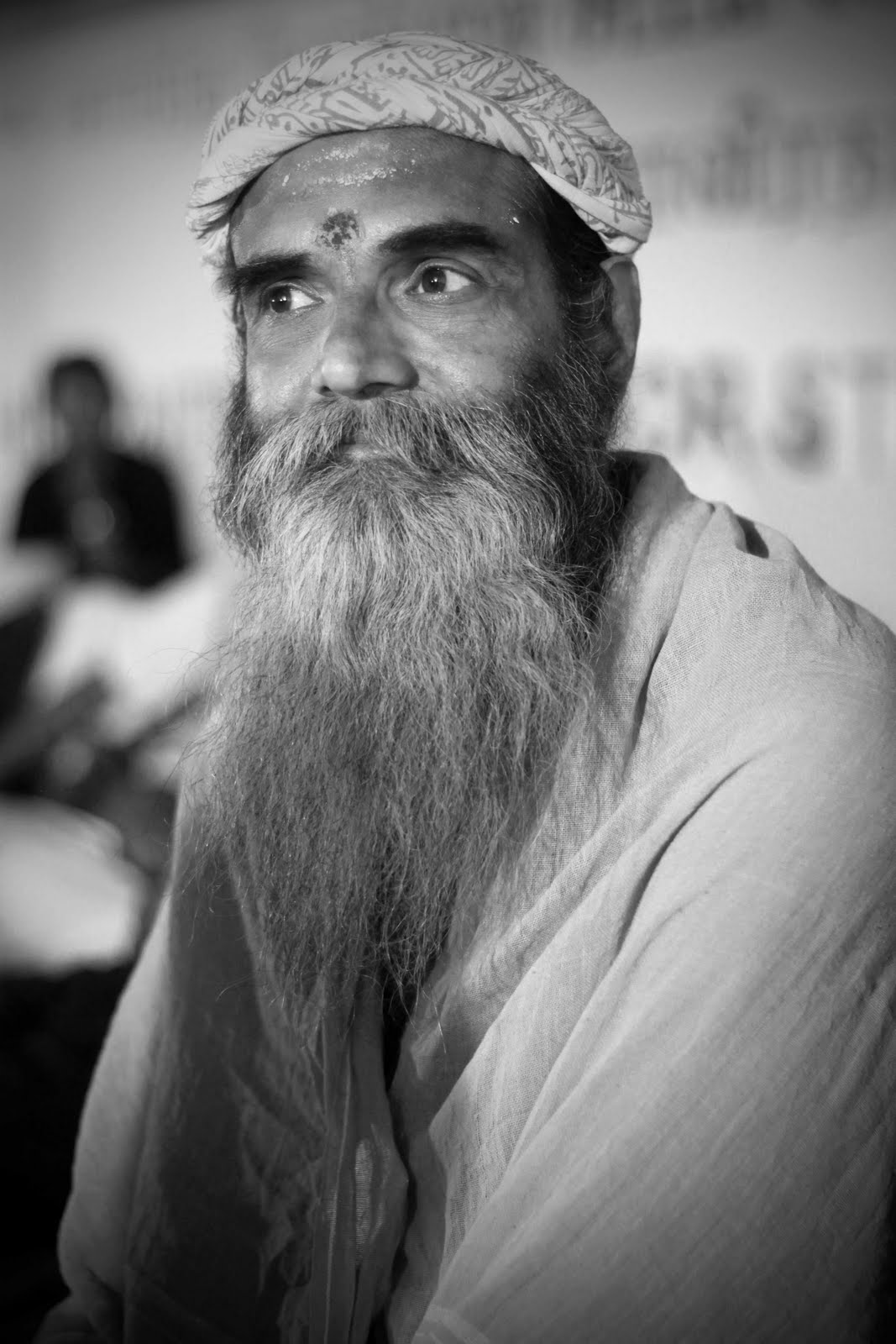
Then there was Sivadas Yogi.

There is more to Sivadas Yogi than the long beard, the saffron outfit and the radiant smile. He is someone who walks the talk, literally. He doesn’t belong to Chennai. He came all the way from Haridwar, on foot. At 64, he prefers to push the limits rather than spend time reading a book in a reclining chair. This man began his journey on January 14th, much before the anti-corruption movement gathered steam. The walk itself was a campaign, as Yogi spread his ideas against corruption wherever he set foot. The seven months on the road has taken him to the length and breadth of the country. He says he used to walk 30 kilometres daily. When asked where he used to sleep, he smilingly said, “National Highways”. After that walk of 6000 odd kilometers, he straightaway joined the indefinite fast at LB road, Thiruvanmiyur. On the 10th day of the fast yesterday, Yogi was much weaker when compared to the first day. But the smile and the spirit were intact. Having said all that, I wonder why yogis and swamis are attracted to activism these days!

AppaIndruvel, who came alone from the other end of Chennai to protest. On the second week, all his family members came to visit him at the fast venue. Even he was visibly tired when I went back on the 11th day. And he had grown a thicker beard too.


I didn't talk to this man. I still can't decipher the meaning of this look.

I dream of protest marches..


something will happen..


The Television spectacle!

The Television channels played a big part in the movement. It almost bordered on the absurd when they went overboard with the coverage. I quit watching TV pretty long time back. From the 'always on' TV at the college canteen I gauged one fact that, in the last 2 weeks, they covered nothing else. All 5 headlines on most of these days were related to Anna and the movement. I am not exaggerating when I say that I didn't see absolutely anything else covered in these channels. This, at a time when there was so much happening, from the latest oil grab in Libya under the garb of a revolution to the unmarked graves with thousands buried, in Kashmir. And, even the coverage of the Anna movement had nothing to write home about. Shallow debates and twitter updates of celebrities talking about Anna, masquerading as news, were the order of the day. Also, the screen split into 9 or 10 panels with the debates ending up as conversations in the Tower of Babel. Times Now and Arnab Goswami best exemplified this TV fuelled revolution. Loud mouthed, partisan coverage subverted meaningful discussions on the bill. Sharad Yadav hit the bulls eye with his clever jab at Arnab today in the Parliament. Times Now was the preferred channel at most protest venues, for reasons best left unexplained.

The aimless...

what am I doing here??!!!why am I holding this??

hmm...maybe!

wired...connected....

There were many who aimlessly wandered in without knowing head or tail about the Lok pal bill. There were groups of friends who came just to have a good time, as observed by a friend who stays near the protest venue. One of these days I saw a group of guys walking on the road with the tri colour painted on their faces and crying out "Bharat Matha ki Jai". I had a sense of dejavu, of coming out of the chinnaswamy stadium last year, after India's series victory against Australia. And the stories about drunk flag waving biker gangs in Delhi as well as near Marina beach here in Chennai are quite disturbing. But not as disturbing as the sight of one of India's biggest crooks, the man with a ponytail who runs that famous management institute which urges us to think beyond IIMs, delivering a speech at RamLila maidan yesterday. Wonder why Anna and his friends give space to such dubious characters! But I dont really subscribe to the cliched criticism of the middle class who are the major strength of the movement. Atleast some of them are in it with good intentions and also with a thorough understanding of what it is all about. So, a generalised criticism of the great Indian middle class is unwarranted for.

As I was walked out through the flurry of OB vans and the chatter of reporters, I still coundn't make up my mind on how good this movement actually was. Sivadas Yogi, the man who walked from Haridwar to Chennai, perhaps signifies the signs of our times, a spurt in activism by the common man. Whether it augurs well for the strength of our democracy is a moot question. But whatever is the outcome of this anti-corruption campaign or whichever side you are on, you can’t help applauding the spirit of men like this Yogi. Feats like his transcend the ephemeral and sometimes over the top movement itself. At the same time, one cant help thinking about the naivety all around, regarding the workings of parliamentary democracy. A first lesson towards understanding this can be done by acknowledging the fact that this movement can't be compared to the revolutions named after sweet smelling flowers that played out in Tahrir square and elsewhere. Many even doesn't seem to have an idea of how lucky we are to be living in this democracy. There are status messages updated daily with ideas like "India needs someone like Hitler", "All politicians are crooks. Kill 'em all"(an idea reflected even by our news channels) etc. The focus on science and engineering in our education system seems to have affected the new generation's history and civics knowledge. Existence of thoughts like these are something that our 'civil' society as well as the 'made to look uncivil' society needs to ponder on. On a lighter note, as my friend quipped, "All this is because of that rang de basanti!" If you go through the history of this blog, you can stumble on some 'rang de basanti' fuelled posts of 'revolutionary ideas' too. Thankfully, I've no such illusions now. But even given all this, it can't be denied that some kind of movement like this was needed to wake up this government which is so drunk on power. Let's not have any illusions about corruption disappearing from tomorrow. For that, each of us needs to get our own houses in order.

As I got out of the gate, the volunteers were still pleading at people to get in and support the movement..."oru sign podungaaa(please put one sign)", so the cry went..

please get out of the bus and sign...he seems to say.


pleeeease staaap maaadam!

ok..wats going on!?

Here's a video that I compiled from the protest venue...

Thursday, June 30, 2011

I apologise...

Over the last few years, I've written quite a few blogs which am not proud of right now on a second reading. Some of those blogs were written in a fit of anger, as reactions to some off incident. The lack of proper research shone through, as did the unwanted usage of expletives. There was lot of rhetoric and as much lack of substance. I would like to use this post to set some of those wrongs straight and apologise to some personalities who were subjected to unwarranted criticism due to lack of knowledge and proper research. And added to that, writing in the heat of the moment resulted in clouded judgement thus producing one sided articles. I would like to apologise to...(Not that any of these personalities gives a damn to what I write...Just that I thought its better to own up your mistakes)


1. Arundathi Roy
I've n't bashed anyone like I bashed her. From making noises about her supposedly pseudo-intellectual behaviour to calling her a bitch, I've done it all in this blog. Till sometime back, I was a firm believer in the unlimited goodness of the nation that is India that I failed to see the shades of grey or rather the total blackness on its part in several cases. And when she talked exactly about those greys and blacks, it made me uncomfortable. For me, anyone who questions the nation was equivalent to a terrorist and so it was easy for me to brand her as one. The idea of state sponsored terrorism was hard for me to swallow, until a certain Binayak Sen went to jail. That opened my eyes to a new world where the state was even worse than some of the so called terrorists or maoists. It was all there for me to see, just that I closed my eyes and shielded my ears to something which went against my beliefs, until a hard enough knock made me wake up. I used to view human rights activists as pests who were out to demean the nation and hog the international limelight. The idea that their presence is a necessity for a healthy democracy dawned on me much later. We need people who risk their lives and ask those hard questions. We need people who lays their reputation in line while expressing their views which might be mis constructed as anti national by vested interests and mis-informed bloggers! I still don't agree with many of Roy's views but now I know that atleast half of which she speaks is true as far as India is concerned. Sorry Ms. Roy, for all those harsh words. You didn't deserve any of those...

2. M.F.Hussain
Now, here comes a double flip. First, I started off as a flag waving member of the 'tolerance' club. I had seen only the 'bharatmata' painting and I found nothing wrong with it. Then I came across a site where some of his 'selected' works were featured. It consisted mainly of Hindu gods and godesses in compromising positions with titles which were formulated to stir up anger. There were one or two paintings of a fully clothed muslim lady(again titled). From that day, I been a strident critic of the man without ever caring to do a research on his body of work. I never had a problem with hindu gods painted in whatever positions he liked. It was the double standards that he supposedly displayed in portraying muslim ladies fully clothed which angered me. And then, recently he passed away. My first reaction was, 'good riddance'. Then, out of curiosity, I decided to dig a little and what it throwed up shocked me. His body of work was massive and the ones featured in the site were drawn sometime in the 60s. Most of those titles in the site(which were designed to stir up anger) were made up by the site owner. Until mid 90s, no one in India really bothered about these few paintings. That was when the Hindutva brigade came into limelight. Once the Ayodhya issue was milked to its capacity, they needed something new to latch on to. Someone digged up the old paintings and thus started an orchestrated campaign to kick Hussain out of India. Sadly, most of us fell prey to that game, hating the man till his death. A quick run through of his work will tell you how these few paintings were insignificant compared to his mammoth repertoire. The bigots never talked about the other beautiful paintings he made of Saraswathi, Gandhari or Mother Teresa. I am not an art connoisseur, but some of those paintings touched even a layman like me(although a large percent just flew over my head!). You can view some of those works here- http://www.mfhussain.com/paintings/ . I feel guilty as well as sad for inadvertently playing a part in drumming up hatred against a great artist. I am no different from those bigots of the Hindutva brigade!

3.V.S.Achuthanandan and the leftists
My criticism of Achuthanandan came with the package of being a staunch anti-leftist(for the first 24 years of my life). I could never empathise with the ideology of a party or a man who came with a red flag wherever some development was about to happen. I could never digest the fact that someone was making such a big fuss about a few huts being relocated for an IT park or some other mega development project. That was until words like corporate plunder, land grab etc entered my dictionary. Come 2008 and there was all the hullaballoo about Achuthanandan's 'dog' remark at late major Unnikrishnan's residence. The night I saw that, I sat down to write and all I could see was an old filthy useless politician making fun of India's slain hero. Once it was published, I got calls from many, including one lady from Mysore who was particularly emotional, asking me whether I've atleast heard of the land reforms that VS helmed. Truth be told, I didn't have an idea of the man's history in Kerala politics before the 90s. I didn't bother to read it up at that time too. It was after several months when I saw 'reason' and 'consistency' on the left side that I bothered to read some history. And boy, din't I repent! The anti-leftism is a thing of the past for me. The left and the few who still believe in that ideology(or atleast the watered down version of it) are an absolute necessity in the Indian political landscape, even if it is in a handful of states. The day the red flag bites the dust completely would surely upset the balance of our democracy.


Stop scrolling Barkha Dutt and everyone of that ilk....am not gonna apologise to you! My opinions on you still stands the same and I don't think I'll ever change it, because some more research did harden that opinion...


From today, I vow never to write anything without proper research. I vow never to use expletives in my writings, so that the message don't get lost in all the din. I vow never to write when I am angry. I vow, even after all this I won't hold it back in cases where it necessitate the presence of a raised finger...!

Tuesday, April 26, 2011

Who will end Endosulfan?

A baby with an abnormally large head, people with deformed faces and deformed limbs, kids walking in crutches, bleeding skins, braindead souls...No, these are not scenes from one of those thousands of hollywood movies depicting death and destruction. Nor are these scenes from an affected village near a nuclear plant. These are scenes that will greet you in many of the villages in Kasargod, a district in Kerala. And the culprit? Endosulfan, an aptly named insecticide which was sprayed over these villages to protect the cashew saplings planted by the plantation board. The spraying over a long period of time contaminated these villages(Muliyar,Padre,cheemeni,bovikanam etc.) to such an extent that there's none around who is not affected with one disease or the other. The variety of diseases is alarming-from simple body pain to cancer, epilepsy and cerebral palsy. Many of the new borns are mentally unstable or deformed at birth. The depth of the horror is such that women in these areas are resorting to abortions to prevent giving birth to stillborns and mentally retarted babies. Besides humans, the chemical also resulted in the death of fishes and other livestock. The poor villagers at first thought all this was caused due to the displeasure of the Gods. All this changed at the end of the 90s when a group of committed individuals like Dr.Mohana Kumar and farmer Sri Padre found out the real reason behind this, spraying of endosulfan in these areas over a period of two decades. This touching photojournalistic work by mathrubhumi photographer Madhuraj throws light on this huge tragedy.
one of the victims of endosulfan(Kasargod,Kerala)

So, reading all that, what will you naturally expect? That this insecticide is already banned in India and the ones behind this behind bars? If you think so, its time to wake up and take in the reality of the new shining capitalist India. Right now, its banned only in Kerala and Karnataka, which the state govts did in their own capacity. But, at the same time there are some high profile govt agents batting for 'endosulfan'. Union minister for agriculture Mr.Sharad Pawar makes the expected appearance at the top of that shameful list of individuals. Few months back, he had told the Parliament that several states and farmers had written to him asking him not to ban endosulfan because it will affect their livelihood. But, earlier this month an RTI application by a journalist revealed that not a single state wrote to the centre against the ban. And the 6 letters recieved by the centre were all from organisations supporting endosulfan. This single incident reveals the vested interests at play here. The surprising thing in the whole episode is that its the govt owned Hindustan insecticides limited that manufactures Endosulfan in India. And, Pawar even made a statement blaming the lack of intelligence of the farmers, who 'doesn't know how to use the insecticide'. Remember, this is an insecticide banned in over 60 countries worldwide. Another high profile supporter of endosulfan is K.V.Thomas, minister of state for agriculture, who recieved a lot of flak for his speeches citing 'lack of evidence' against endosulfan. There's a big lobby at play behind the stage, including Pesticide Manufacturers and Formulators Association of India (PMFAI) and Endosulfan Manufactures & Formulators Welfare Association (EMFWA). They've spread this opinion that banning endosulfan will is against the interests of poor farmers in India as its the cheapest insecticide available in the market. They've cleverly suppressed the fact that there are cheaper alternatives available with none of these horrible side effects.
a man with deformed limbs, thanks to endosulfan

The Stockholm convention is an international treaty that aims to eliminate persistent organic pollutants(source-wikipedia), the ones which are resistant to environmental degradation. The latest meeting of this convention took place yesterday(April 25th). There's been calls from all over to the central govt to support the banning of endosulfan at stockholm. Kerala chief minister V.S.Achuthanandan went on a fast yesterday asking for the ban. The centre made its intentions clear at the outset with various ministers voicing opinions that it won't be banned all over the country. The point they made is the 'lack of scientific evidence' to prove that its endosulfan that caused the diseases in various parts of Kerala and Karnataka. And, this is at a time when there are more than 20 studies available worldwide on the ill effects of endosulfan. Even Jairam Ramesh(known for his occasionally tough stand to suppport the enviornment) washed his hands off. And as expected, at the stockholm convention yesterday, India opposed the banning of Endosulfan as a representative of the Asia pacafic region. The draft statement is availabale here. You can see statements like "Significant adverse health and environmental effects of Endosulfan is not established", "The fact that sustainable economic and social development andreadication of poverty are the first and overriding priorities of the developing country.Parties will be taken fully into account, giving due consderation to the need for protectionof human health and the environment.” Yes, our leaders have betrayed us again. India's plan was atleast to get the ban delayed, because the next stockholm convention takes place only in 2013. Our country's conduct in the world stage is beginning to look more like that of US these days, pandering to the whims and fancies of corporations and forgetting the common man.

For every Kalmadi and Raja arrested, we have 100 others like them still sitting firm in the ministerial chairs. Corruption doesnt mean just big money siphoned off in big scams. It also involves cases like these where there's a clear case of vested interests at play. Only this time, the devilishness of that self interest puts the life of thousands in jeopardy. As those kids walk on crutches, as the baby with that big overgrown head cries out in pain, as the adult man comes to terms with his kiddish intelligence, the greedy ilk does a death dance over their head with their own deafness and blindness to the plight of those suffering thousands. The brashness, the deafness and the cold bloodedness point to a rot in this system, which needs some serious cleaning, morally and literally.

What more proof they need to ban this? How many more deaths do we want? How many more should be deformed?


Friday, April 08, 2011

India against corruption:The Bangalore Satyagraha

This post was written before the news came out about the govt agreeing to all demands of Anna Hazare and his supporters. Below is what happened on April 7th(3rd day of the fast) at Bangalore.


When Anna Hazare speaks, the country listens. His never ending struggles have given us the RTI act, caused many corrupt politicians to lose their jobs and also gave us the hope that one man can ignite a flame big enough to wake up a whole nation. With his ongoing fast against corruption and for the implemetation of the 'Jan Lok Pal bill', he has done just that, yet again. The first day's fast(on april 5th) was lost in the euphoria of India's world cup victory. But, by the second day many started asking 'who's anna hazare?'. And by the 3rd day, a large majority of Indians knew Anna and each point of the Jan Lok Pal bill. Fasts and candle light vigils are happening all over the country right now.
Few of those who are undergoing the indefinite fast

a warning to yeddy man and all the politicians in India

On the 3rd day(April 7th), me and my friend Romel decided to join the satyagrahis at Freedom park in Bangalore. The idea of fasting had never crossed my mind in my 25 years of existence, until today. Anyway, on thursday morning, instead of going to office, we headed in the opposite direction to Freedom park. We were disappointed to see just a small group of 15 people sitting there(too bad for a city of almost 1 crore population). Out of this, 6 of them were fasting non stop for the last 3 days, right from the minute Anna Hazare started. Among them were M.K.Gandhi, yoga instructor and Ashuthosh, an entrepreneur. A retired teacher tried to cheer the satyagrahis up with soulful renditions of Gandhi Bhajans. Then, slowly the crowd began to swell.

some success

wish atleast half of those came out after India's world cup victory truned up for this movement...

An autodriver(name forgotten) was there from morning till evening, sacrificing his day's earnings. If he can do it, why can't we, the salaried class? His presence and his speeches went a long way in reducing my hatred towards Bangalore's autowallahs. Indeed, there are good people everywhere(even among HRs :P ). There was a little kid too, with her colouring book, intermittently snatching the placard from her mother. M.K.Gandhi spoke about how corruption is deep rooted by citing an example of him being asked for bribe by the security at the freedom park yesterday night for letting him use the restroom. Environmentalist Yellappa Reddy spoke at length about how corrupt officials are killing our forests. Many of whom turned up talked about their personal experiences with corruption. It was evident, very few(none?) are left untouched by this evil in India. In between all this, there were some who tried to use this stage for their own personal agenda. This included a group of college kids who came with 'ABVP' banners and another group of 'kannada activists'. Thankfully, the organisers told them politely that no other agendas are allowed other than Jan Lok pal bill and anti-corruption.

M.K.Gandhi, one of the 12 who are undergoing indefinite fast at freedom park....
Yellappa Reddy,famous environmentalist


an autodriver who spent the whole day at the freedom park....sacrificing his day's earnings....If he can do it, why cant the high salaried class do it!

the kid too decided to put in her might, so as to protect her futuresometimes she went back to her colouring book

By noon, the crowd swelled again, thanks to a big bunch of college students who came in their college buses. These college managements has to be appreciated for taking such thoughtful steps. The students' spirited sloganeering brought the freedom park to life. With placards in support of Anna Hazare and his movement, they strode in and filled up the park. The media was in good strength too by this time. It was a pleasure to see the empty venue getting filled up gradually. After 2, we had to leave to finish our duties at office. But we continued our fast till night, making it 24 hours. And, it was not as hard as we thought.

college students shouting slogans in support of Anna Hazare

high spirited!

future leaders..

an apt venue for the fast


romel, who accompanied me to the freedom park.

more placards


a lady speaking about her tryst with corrupt public servants

people signing up for the movement

On wednesday, when I decided to go for this, I heard so many highly negative comments from all around. I read similar comments in various online communities and in our office bulletin board. It was the same old 'Nothing's gonna change here', 'whats the use', 'This won't work' kind of comments. Thankfully only few congress,BJP symathisers and ultra pessimists share this view. They came up with all kinds of conspiracy theories like Anna Hazare is trying to gain a back door entry to government and that 'civil society' will hamper the development of this country. Either these people are utterly hopeless fools or are acting like fools even after knowing the facts. So, stamp out the negativity. Get out and support in whatever way you can. Your presence at the venues can make a lot of difference(even if its for an hour). This might or might not be a success. But the fact that atleast some of us will now think twice before paying a bribe can bring about a change. Wish atleast half of those who came out at midnight to cheer the Indian cricket team's world cup win, turns up for this.

Check the location and contact person in your city at this link- http://indiaagainstcorruption.org/citycontacts.php

The complete draft of the Jan Lok Pal bill and everything that you need to know about the issue is available in the site- http://indiaagainstcorruption.org/

It was heartening to see a big crowd of software engineers take out a protest march all over electronic city today evening.

your crusader Praveen